

If you walked into a movie theater where current events were projected onto the screen as dystopian fiction, you wouldn’t believe it. None of us would. It’s just too much, too grotesque a caricature of human depravity. But… here we are.
Our world is currently careening towards the fever-dream of techno-surveillance lockdown. This version of our world has lost the thread of the story of home. We can no longer find ourselves in our infrastructures, in the places we live and work and raise our kids, in work that should validate the energy, agency and creativity that flows through us, or in the country that used to feel like home.
Some days, I wake up feeling mute shock as I bear witness to the speed at which it’s all unravelling.
In a world unmoored, what grounds us? What brings us home?
There’s a hunger in humans that no amount of productivity, renumeration, or virtual connection can satisfy — the hunger to truly belong, to be known, to matter within a web of human and more-than-human relationships. We find homecoming: the felt sense of arriving in real relationships, with real people and real fields of consequence, in real places that holds us. This kind of ground isn’t just a romantic or spiritual ideal, but a recognition of the deeper meaning of the very concept of home – a concept that can’t not be relational.
Cultures of homecoming are not built through grand gestures or institutional design, but through three foundational eco-social principles practiced in daily life — integrity with oneself, reciprocity between people, land and the more-than-human world, and complementarity within our ecologies of relationship. These three traits play together to nurture the interstitial weavings of a world where we feel safe, sane and sacredly held. They are lived through daily actions as simple as a returned glance and as deep as a life devoted to tending unknown future cultures. Together, they form the reciprocal feedback loops through which genuine belonging and homecoming grows.
I. Integrity: The Root System
Everything begins here. Before we can truly give to another, truly sense what a moment requires, or truly show up in the fullness of what we are, we must first be honest with ourselves. Integrity, in this sense, is not a moral principle. It is an ecological act — the act of knowing and honoring one’s own needs, values, energies, time, attention, means, and context, and allowing that honest knowledge to guide how we move in the world.
Consider the simplest expressions of this. A person who knows they are depleted and says so, rather than agreeing to something they cannot give. A person who declines an invitation not out of indifference but out of respect for the limits of their own attention. A person who speaks their actual values in a room where it would be easier to stay quiet. These are small acts. But they are the acts through which you remain real — and only real people can create real culture.
Without integrity, the whole system begins to falsify. When we say yes and mean no, when we give what we do not have, when we suppress what we actually think or feel in order to be acceptable — we hollow out the very self that others need us to be. We become, in a sense, ecologically absent even while physically present. Others cannot orient themselves around us, because we are not actually there. And we cannot orient ourselves around others, because the instrument through which we read the world — our own honest interiority — has been set aside.
Integrity also means claiming one’s own needs as legitimate. This is harder than it sounds in a culture that often equates self-awareness with selfishness. But a person who knows they need silence, or creative work, or time in nature, or honest conversation — and who honors that need — is not withdrawing from community. They are tending the conditions that make genuine community possible. Your limits are not failures. They are accurate information. A system can only work with what is actually there.
The image that fits here is that of a tree. Integrity is the root system — invisible, unglamorous, and absolutely essential. The deeper the roots, the more generously the branches and fruit. A person who is grounded in honest self-knowledge can be genuinely receptive, genuinely present, genuinely responsive — because their attention is chosen rather than compelled, their giving is real rather than performed. Integrity does not make a person rigid. It makes a person reliable. And reliability is the first gift we bring to any relationship.
II. Reciprocity: The Pulse of Relation
From the ground of integrity, reciprocity becomes possible. Reciprocity is the pulse of human relationship — the basic rhythm of giving and receiving that runs through every genuine exchange. It is not a ledger or a tit-for-tat. It is something more like breathing: a natural alternation between extending and receiving that keeps the body and soul alive.
Its simplest forms are almost invisible in their ordinariness. Someone holds a door; the other person nods in acknowledgment. A smile is returned. A wave answered. Someone listens attentively to a story, and later, their own words are received with the same quality of attention. Someone covers a friend’s coffee today; the friend picks up the check next week without anyone counting. These small exchanges are not trivial. They are the constant, daily weaving of the social fabric. They say, again and again: I see you. You matter here. This is a place where things flow both ways.
What is striking about reciprocity is how viscerally we feel its absence. A conversation that only flows one direction, a friendship where one person always carries the weight, a community where giving and receiving are distributed wildly unevenly — these register not just as unfair but as somehow wrong, as a violation of something natural. That felt sense of wrongness is important information. It tells us that reciprocity is not merely a social convention. It is a biological and ecological norm, wired into us by millions of years of interdependent living.
Reciprocity also includes receiving well. This is often overlooked. To receive graciously — to allow someone’s gift, their help, their attention to land — is itself a form of giving. It completes the circuit. A person who cannot receive, who deflects every kindness or insists on self-sufficiency even when it isolates them, interrupts the flow just as surely as someone who only takes. Cultures of homecoming are cultures where it is safe to need, safe to receive, safe to be incomplete and held anyway.
And reciprocity isn’t just a practice between humans. It’s a thing we offer to the land, to food system, to the plants that accompany us in our homes, and the mountains that move us to dream bigger. It’s the gratitude you offer for the fish, rice and broccoli you have for dinner, and the awe you speak to the waterfall as you receive it’s cleansing blast. It’s the water you put out for thirsty wildlife and the council meetings you go to create policies to protect their habitat. It’s the will to feed what feeds (and clothes, and houses, and fuels) you.
The practice of reciprocity, lived from integrity, is also the training ground for trust. Every small exchange honored — every returned acknowledgment, every kept promise, every moment of attention genuinely given — builds the quiet accumulation of trustworthiness that makes deeper belonging possible. Culture is made of these moments, not of policies or programs. The pulse is built one beat at a time.
III. Complementarity: The Ecology of Togetherness
Beneath reciprocity lies something even more fundamental: the felt sense that we are not separate units exchanging resources, but differentiated parts of a living whole — each carrying something the others need, each shaped by capacities and limitations that, together, form a functioning system. This is complementarity. It is what happens when people stop merely exchanging and start genuinely fitting together.
Where reciprocity says I give, you give, complementarity says you carry this so I can carry that, and together we carry what neither of us could carry alone. It is the difference between a market and an ecosystem. And it is recognizable in the most ordinary moments of shared life.
One person speaks; another listens — not taking polite turns, but genuinely needing both roles at that moment. One person holds the practical details of a project while another holds its vision. In grief, one person collapses and another steadies — and later, when the roles reverse, neither one needs to explain. Someone in a group becomes the anchor, another the spark, another the bridge between factions — not by assignment but by instinct, by some felt sense of where they are needed and what they can offer. These are acts of complementarity. They are how organisms function, and they are how healthy communities function too.
What distinguishes complementarity from mere division of labor is that it is felt rather than managed. It arises from presence and attunement, not from organizational charts. It requires each person to be genuinely themselves — to bring their actual capacities, their real strengths and honest limitations — so that the group can organize itself around what is truly there. This is why integrity is the root. You cannot contribute your genuine complementarity if you have suppressed or hidden what you actually are.
The most profound acts of complementarity are wordless. Simply being present in a particular way — steady, or playful, or curious, or warm — can complete something in a room without a word being spoken. Two people sitting in comfortable silence, each making the quiet feel safe for the other. A person who remembers what another has forgotten. Someone who carries hope for a friend who has temporarily lost theirs. These are not heroic. They are the ordinary miracle of people genuinely attuned to one another — sensing the whole, sensing where the gaps are, and moving to fill them without being asked.
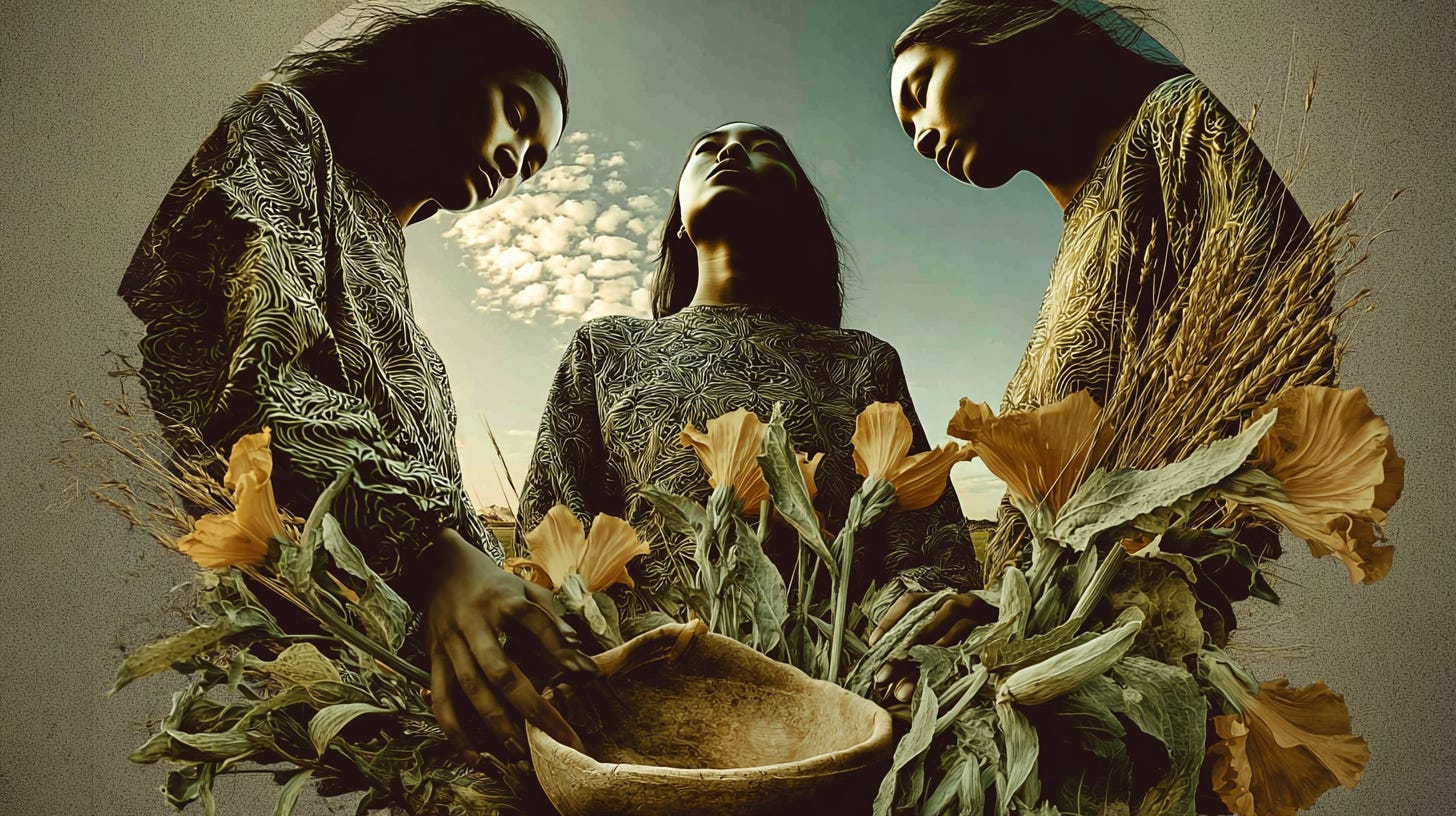
The Three Sisters — corn, beans, and squash — offer a living lesson in complementarity, the principle that distinct elements flourish precisely because of their differences rather than despite them. Corn rises tall, offering its stalk as a trellis for the climbing bean vine. The bean, a nitrogen-fixer, draws fertility from the air and feeds it back into the soil, nourishing both its companions. Low-spreading squash carpets the ground with broad leaves that shade out weeds, hold moisture, and keep the soil cool. None of the three could create this abundance alone — it is their radical difference, their willingness to occupy entirely distinct roles, that generates the whole. This is complementarity: not sameness, not compromise, but the generative power of irreducibly different natures in right relationship with one another.
To live complementarily is to accept, with some grace, that we are incomplete — and that this is not a flaw but a design. We are made for each other in the most literal sense: shaped to fit, shaped to need, shaped to offer what we specifically have to the specific others in our lives. A culture of homecoming is one in which this is not just tolerated but celebrated. Where difference is understood not as a problem to be managed but as the very richness that makes the whole more than the sum of its parts.

Coming Home
A culture of homecoming is not built by accident. It is built, one ordinary moment at a time, by people who have learned to be honest with themselves, generous with others, and attuned to the living whole they are part of. Integrity gives us the root — the grounded, honest self from which all genuine relation flows. Reciprocity gives us the pulse — the daily rhythm of giving and receiving that weaves the social fabric and builds trust. Complementarity gives us the ecology — the felt sense of belonging to a whole greater than ourselves, in which our particular presence and our particular needs are both real and welcome.
These three principles are not ideals to aspire toward from a distance. They are practices, available in every conversation, every encounter, every moment of honest self-knowledge and genuine attention. Where they are lived, culture shifts. People feel it. They stop performing and start arriving. This is the antidote. The daily medicine. That practice and the possibility.
Even as the world unravels, each of us has the capacity to nurture zones of homecoming, health and belonging. It’s not difficult. It’s vital, sense-affirming and regulating. And, it makes things make sense.
We can do this.
Will you join me in nurtuting these eco-social foundations of a world that we can mutually feel as home?
beautiful explanation of principles for systemic wholeness, thank you!